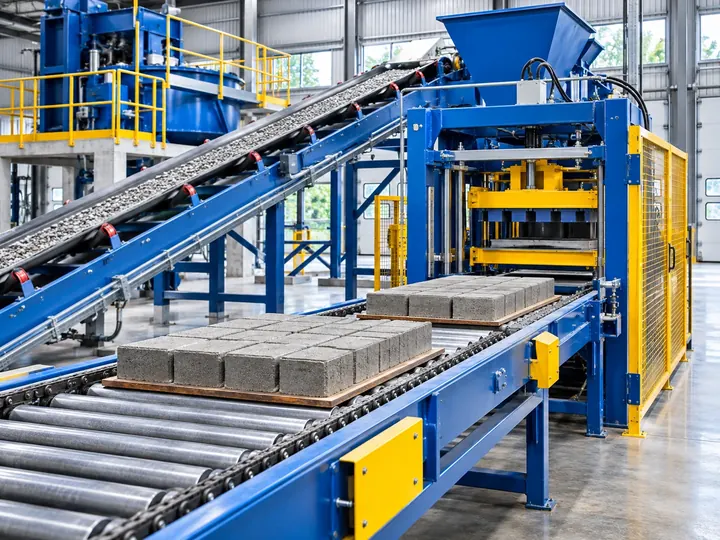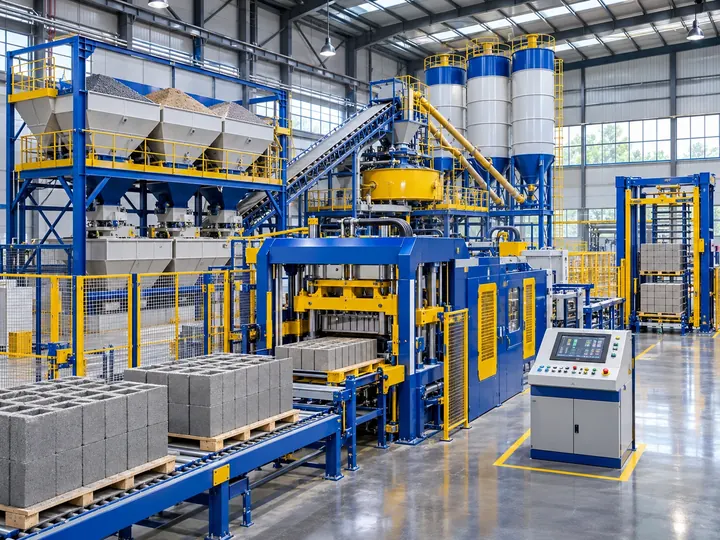

GCM WS-26 Washing Finish Machine
Inline surface-washing system using multiple spray nozzles to create washed or aged finishes on compatible concrete products.
Technical Specifications
| Special nozzles | 28 |
|---|---|
| Spray arrangement | 2–3 rows of spray heads |
| Installation concept | Inline at the product output / finishing section |
Concrete Recipe and Timing Matter
A washing process interacts directly with the surface mortar and aggregate. Recipe, initial setting condition, nozzle pressure and treatment timing all affect the final appearance.
Water Management
The installation should include drainage, sediment control and suitable water-management planning so the finishing area remains practical to operate and maintain.
Trial Products
Finish quality should be established through trials before full production because pigment, aggregate and face-mix composition can change the result significantly.
Key Features
- Multi-nozzle controlled washing
- Can create exposed or aged surface effects depending on concrete recipe
- Inline arrangement reduces separate manual handling
- Treatment can be coordinated with product speed
Typical Applications
- Washed pavers
- Decorative concrete products
- Exposed-texture landscape units
Production-Line Engineering
In the context of GCM WS-26 Washing Finish Machine, final equipment selection should be based on the complete plant rather than a single machine. Required output, product dimensions, concrete recipe, pallet flow, curing method, downstream handling, available factory area and automation level must be evaluated together.
When the Product Is Ready for Finishing — GCM WS-26 Washing Finish Machine
GCM WS-26 Washing Finish Machine should be configured for exposed-aggregate finishes using controlled washing. The first engineering step is to define product age, feed speed, treatment depth, tool or abrasive condition, water flow, dust extraction, product thickness and target finish. These values determine whether the equipment will work comfortably inside the intended production window or will constantly need corrective adjustment. Settings should be established with the actual raw materials, product geometry and tooling that will be used in production. A machine that is stable at a realistic operating point usually delivers more saleable output over a shift than a machine pushed to a theoretical maximum that causes frequent stops, rejects or excessive wear.
Controlling Surface Depth and Texture — GCM WS-26 Washing Finish Machine
The main process objective for GCM WS-26 Washing Finish Machine is uniform texture, controlled exposure, clean edges, dimensional stability, repeatable colour appearance and minimal surface damage. That requires the machine and its tooling to work as one system. Product dimensions, contact surfaces, alignment and material condition should be checked during setup and after defined production intervals. When a visible defect appears, the team should avoid changing several settings at once. A disciplined sequence—material condition, tooling condition, machine alignment, process settings and handling—makes the root cause easier to find and prevents temporary adjustments from hiding a mechanical or material problem.
Feed Speed, Tool Condition and Repeatability — GCM WS-26 Washing Finish Machine
GCM WS-26 Washing Finish Machine does not create factory capacity by itself. It must remain synchronized with curing release, infeed conveyors, finishing machine, water or dust treatment, inspection, drying when required and packaging. Each interface needs enough capacity for normal production and a sensible response to short stoppages. Buffering can help, but excessive buffers increase pallet inventory, floor area and work in process. During layout review, follow the material and product path from receiving to dispatch and confirm transfer heights, maintenance zones, lifting access, safe walking routes and forklift movement. This process-flow check often identifies practical restrictions that are not visible in an isolated machine datasheet.
Dust, Water and Waste Management — GCM WS-26 Washing Finish Machine
Operators should monitor signs that show whether GCM WS-26 Washing Finish Machine is running consistently: cycle behaviour, product appearance, abnormal noise, temperature, vibration, hydraulic response, transfer timing and recurring alarms as relevant to the equipment. Quality staff should connect these observations with measured product results. Trend data is more useful than isolated readings because gradual wear or material drift can be detected before it creates a large batch of nonconforming product. Approved reference samples and documented machine settings are especially useful after mould changes, maintenance work or the introduction of a new recipe.
Quality Approval With Reference Samples — GCM WS-26 Washing Finish Machine
Planned maintenance for GCM WS-26 Washing Finish Machine should cover brushes, media, hammers, blades, polishing heads, pumps, nozzles, bearings, extraction equipment and protective guards. The maintenance plan should distinguish daily cleaning and visual checks from weekly inspection, periodic adjustment and planned shutdown work. Wear limits are better than waiting for failure. Critical spare parts should be selected according to lead time and the consequence of a failure, while replacement history should be recorded so recurring problems become visible. Service access should be considered in the factory layout, because a component that can be reached safely and quickly is far less expensive to maintain over the life of the line.
Wear Components and Routine Cleaning — GCM WS-26 Washing Finish Machine
Automation should make GCM WS-26 Washing Finish Machine more repeatable without making the process opaque to the production team. Recipe control, interlocks, alarms, counters and automatic sequences should have clear ownership and backup procedures. Operators need to understand what the machine is trying to achieve, what conditions must be present before a cycle can continue and how to recover safely from normal faults. Supervisor permissions can protect critical parameters from accidental changes, while maintenance modes should support diagnostics without bypassing safety. Good training covers abnormal conditions and shift handover, not only normal start and stop procedures.
Integration Before Packaging — GCM WS-26 Washing Finish Machine
Before the final configuration of GCM WS-26 Washing Finish Machine, confirm the available electrical supply, floor and foundation conditions, clear height, doors, lifting equipment, water or compressed air where required, ambient conditions and the planned installation sequence. The customer and supplier should also agree which connections belong to the machine scope and which belong to the site contractor. Drawings should show operating space and maintenance space. For export projects, transport dimensions, packing, unloading equipment and the order in which equipment reaches the building can affect commissioning just as much as the machine specification.
Value Added Versus Finishing Cost — GCM WS-26 Washing Finish Machine
The commercial evaluation of GCM WS-26 Washing Finish Machine should include value added per square metre, consumables, tool life, water or dust management, rework, line speed and premium product positioning. A lower purchase price can be offset by additional labour, frequent stoppages, high consumable use or short wear life. The highest automation level is not automatically the most economical either; it should match expected sales volume, labour conditions and maintenance capability. Compare at least a base-demand case and a growth case, then identify which future upgrades can be added without replacing major equipment. This approach produces a clearer investment decision and keeps the factory aligned with the products it can realistically sell.